
📚 GRE Vocabulary: The Words You’ll Actually See on the Test (Deep Guide)


Why Vocabulary Is the Secret Weapon of a High GRE Score
Let’s be honest, GRE vocabulary has a fearsome reputation.
Obscure Latin roots. Archaic adjectives. Words for “angry,” “confusing,” and “unclear” that you’ve never heard in your life.
And yet, here’s the truth:
You don’t need to memorize 3,000 flashcards or spend hours with random word lists. What you do need is a focused, intelligent strategy that targets the words the GRE actually tests — and teaches you to use them in context.
The Verbal Reasoning section isn’t just about definitions. It’s about:
- Choosing the right word for a precise tone
- Recognizing subtle connotations
- Spotting synonyms that don’t quite mean the same
- Understanding how word choice shapes meaning in a sentence
In this guide, we’ll go far beyond lists. You’ll learn:
- The type of vocabulary GRE really tests
- A curated list of high-frequency GRE words
- How those words appear in real exam contexts
- Strategies to master vocabulary efficiently
- Common mistakes to avoid
- A practical weekly study plan
And if you want structured support including word lists based on real ETS data, contextual quizzes, and feedback from expert instructors explore our GRE preparation course at American School Online, where we specialize in helping international students crush the Verbal section.
Lorem ipsum dolor sit amet, consectetur adipiscing elit. Ut elit tellus, luctus nec ullamcorper mattis, pulvinar dapibus leo.
🧠 What Kind of Vocabulary Does the GRE Actually Test?
The GRE is not a test of how many obscure words you know. It’s a test of how precisely and flexibly you understand English vocabulary in context.
Here’s what ETS is really testing:
- Nuance and connotation: Can you tell the difference between placate and appease?
- Tone and register: Do you know when a word sounds formal, academic, sarcastic, or neutral?
- Synonymy and contrast: Can you spot two words that mean the same thing — or one that subtly changes the meaning?
- Context-based reasoning: Can you infer the meaning of a new word based on how it’s used?
Most vocabulary appears in three types of questions:
- Text Completion: Fill in one to three blanks with the best word based on context.
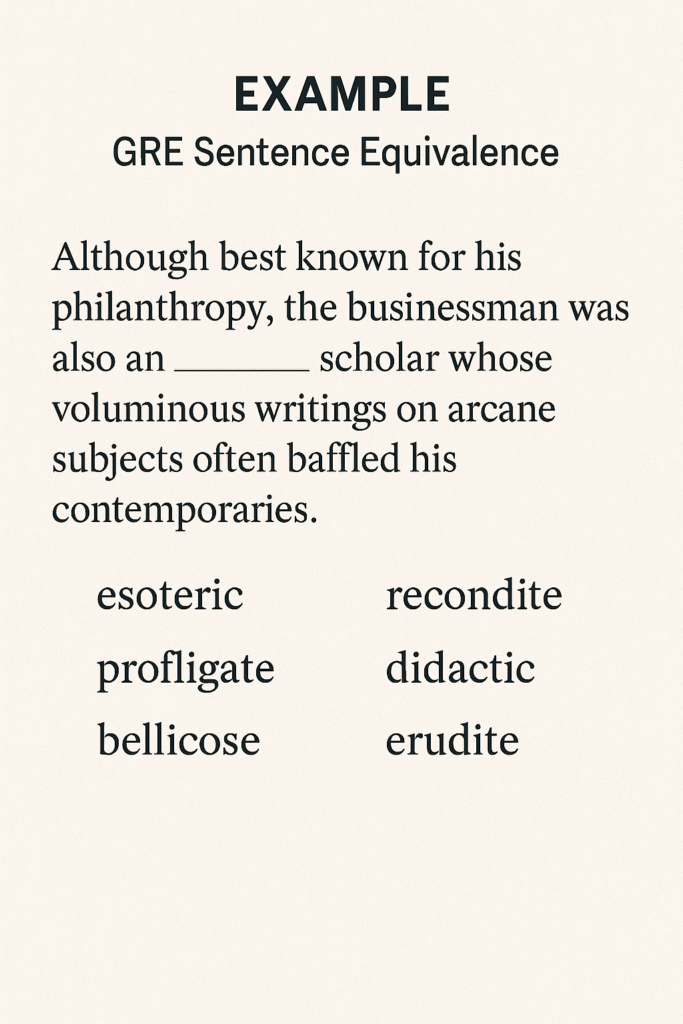
- Sentence Equivalence: Choose two words that complete the sentence and create similar meanings.
- Reading Comprehension: Understand vocabulary in passages about science, politics, history, and more.
Words are often embedded in formal, argumentative, or abstract contexts, where nuance matters more than literal meaning.
📈 The Psychology Behind GRE Vocabulary Questions
ETS uses vocabulary to test reasoning, not rote memory. That’s why:
- A familiar word might appear in an unfamiliar context.
- Two synonyms might both be technically correct, but only one matches the tone.
- The question might hinge on contrast words like although, despite, or however.
Example:
“Although the scientist’s early theories were considered ___, later research revealed numerous flaws.”
Options:
A) incontrovertible
B) erroneous
C) laudable
D) prescient
E) trivial
F) cogent
Here, although signals a contrast. The early theories were considered praiseworthy or well-reasoned, but later turned out flawed. The correct answers are C (laudable) and F (cogent).
💡 This is why memorizing definitions is never enough. You must understand how words function inside sentences.
✅ 50+ High-Frequency GRE Words (Grouped by Category)
These words frequently appear on real GRE questions, practice exams, and official ETS materials.
🎯 Words About Argument or Logic
- Refute – to disprove with evidence
- Bolster – to support or strengthen
- Undermine – to weaken or damage subtly
- Plausible – seemingly reasonable or possible
- Fallacious – logically unsound or deceptive
- Substantiate – to provide evidence or proof
- Corroborate – to confirm with supporting evidence
- Rebuttal – a counterargument to a claim
🧠 Words About Intelligence, Knowledge, and Understanding
- Erudite – deeply scholarly and knowledgeable
- Lucid – clear and easy to understand
- Pedantic – overly concerned with minor details
- Esoteric – known only to a specialized few
- Didactic – intended to teach, often overly so
- Cogent – logically convincing
- Astute – sharp, perceptive, and insightful
- Inchoate – just beginning, not fully formed
😠 Words About Emotion and Behavior
- Truculent – aggressively defiant
- Obsequious – overly flattering, submissive
- Laconic – brief, using few words
- Apathetic – lacking emotion or interest
- Capricious – impulsive and unpredictable
- Belligerent – hostile and aggressive
- Sanguine – optimistic, especially in adversity
- Mercurial – subject to sudden mood changes
💬 Words About Speech and Tone
- Cacophony – harsh, jarring noise
- Loquacious – very talkative
- Taciturn – quiet and reserved
- Irascible – easily angered
- Eloquent – fluent and persuasive in speech
- Bombastic – pompous or inflated speech
- Verbose – wordy, using too many words
- Reticent – reluctant to speak
💡 Abstract and Philosophical Words
- Ambivalent – having mixed feelings
- Ineffable – too great to be expressed in words
- Prevaricate – to lie or avoid the truth
- Obfuscate – to confuse or make unclear
- Anomaly – something unusual or unexpected
- Paradigm – a model or framework
- Ubiquitous – present everywhere
- Auspicious – favorable or promising
📌 Want the full list of 300+ words with context-rich examples? It’s included in our advanced GRE vocabulary toolkit for enrolled students.
🧪 How the GRE Tests Vocabulary (and How to Outsmart It)
The GRE rarely asks “What does X mean?” Instead, it tests words in tricky sentence structures.
Example 1 – Contrast marker trap:
“The lecture was far from ___; students found it confusing and disorganized.”
Correct: lucid or coherent (the sentence implies the opposite of confusing).
Example 2 – Tone-based inference:
“The critic’s review was so obsequious that many doubted his sincerity.”
If you don’t know obsequious, the negative tone around “doubted” and context of criticism hints at something overly flattering.
Example 3 – Context over definition:
“The novel’s popularity was an anomaly in an era dominated by nonfiction bestsellers.”
Here, anomaly = something unusual — not inherently positive or negative.
💡 Pro Tip: Always read GRE sentences twice — once for meaning, once for tone. The second pass often reveals the right word.
📝 How to Study GRE Vocabulary Effectively
Flashcards alone won’t get you a top score. Instead, use a multi-layered approach:
1. Learn Words in Context
For each new word, write:
- Its definition
- A sentence from a real article or GRE question
- Your own example sentence
Example:
- Obfuscate – to make unclear
- “The politician tried to obfuscate the facts.”
- “The professor’s vague explanation only obfuscated the main idea.”
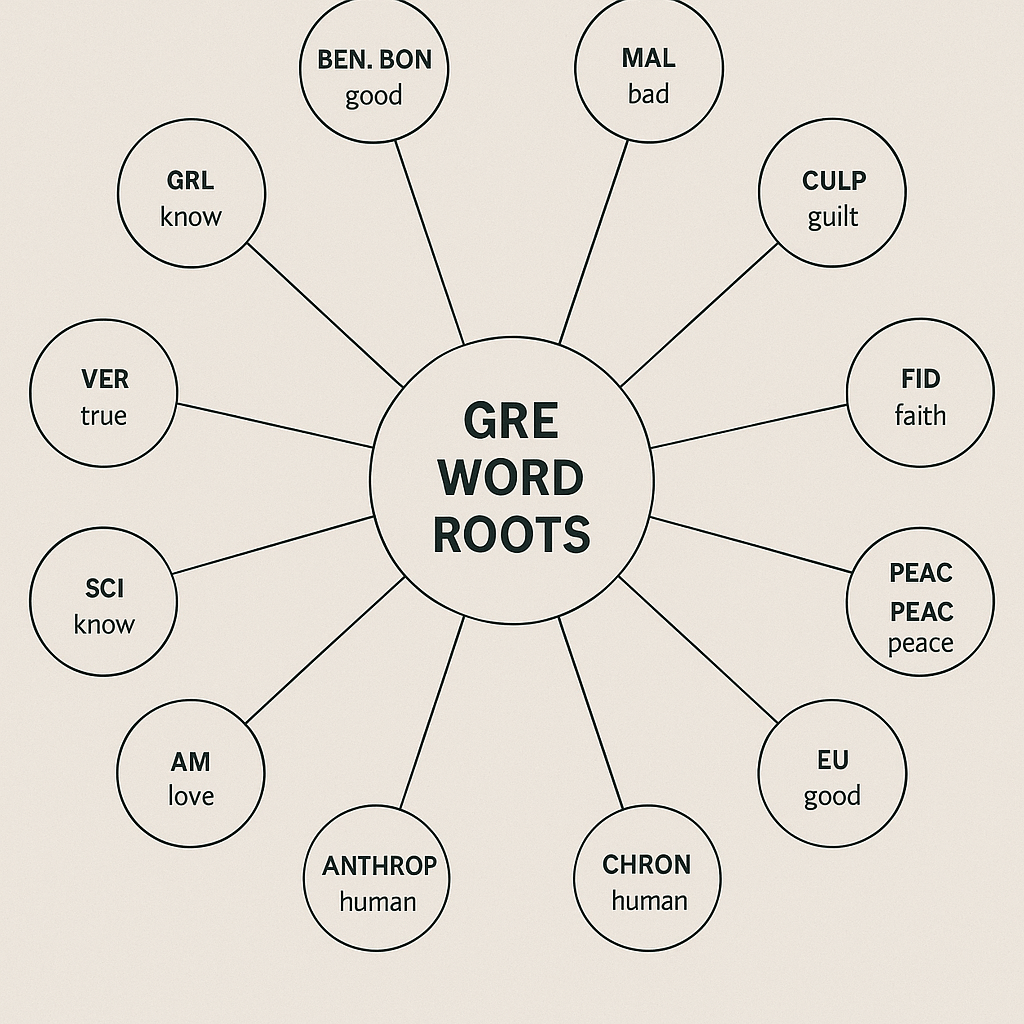
2. Group Words by Root and Family
This builds intuition for unfamiliar words:
- bene- (good): benevolent, benefactor, beneficent
- mal- (bad): malicious, malevolent, malfeasance
- -dict- (speak): dictate, contradict, prediction
Once you know the root, you can often guess meanings even if you haven’t seen the word before.
3. Use Word Pairs and Opposites
Many Sentence Equivalence questions rely on synonyms or antonyms. Study them together:
- loquacious ↔ taciturn
- bolster ↔ undermine
- obfuscate ↔ clarify
- apathetic ↔ fervent
4. Teach the Words
If you can explain a word clearly to someone else, you truly understand it.
This technique — called the Feynman method — accelerates retention.
5. Integrate Vocabulary Into Daily Reading
Read 15–20 minutes of advanced English daily:
- The Economist
- Scientific American
- Foreign Affairs
- Long-form essays and op-eds
Highlight unfamiliar words and add them to your study list.
📆 A 4-Week Vocabulary Study Plan
Here’s a simple yet powerful plan for mastering essential GRE words:
Week 1:
- Learn 50 words (10 per day, 5 days)
- Group them by category (tone, logic, abstract)
- Make example sentences
Week 2:
- Add 50 new words
- Create synonym/antonym flashcards
- Review Week 1 words daily
Week 3:
- Add 50 more words
- Practice 15–20 Text Completion questions
- Write short paragraphs using new words
Week 4:
- Focus on review and application
- Take a full-length Verbal practice section
- Analyze which words you missed and why
💡 Daily time required: 20–30 minutes — enough to see results in 3–4 weeks.
❌ Common Mistakes to Avoid
- Memorizing without context: Knowing a definition is worthless if you don’t recognize tone or usage.
- Using random vocab lists: Many online lists are outdated or irrelevant to the GRE.
- Ignoring word pairs: Sentence Equivalence often hinges on synonym recognition.
- Skipping Reading Comprehension: Many key words appear only in RC passages.
🧠 Practice Makes Permanent
The best way to learn vocabulary is to use it:
- Add 10–15 new words per week
- Review previous words daily
- Do official GRE Verbal questions weekly
- Write short analytical summaries using new words
And if you want structured quizzes, curated lists, and feedback from expert instructors, join our GRE Verbal training program and accelerate your progress.
🎓 How American School Online Helps You Master GRE Vocabulary
Our GRE Verbal course goes beyond flashcards. You’ll get:
- Curated word lists based on real ETS usage
- Contextual examples and sentence exercises
- Adaptive quizzes that mimic test-style questions
- Spaced repetition tools to boost memory
- Dedicated support for non-native speakers
📚 Enroll today in our GRE preparation course and get your free GRE Vocabulary Starter Kit — the fastest way to turn words into points.
📌 Related Articles
- GRE Verbal Reasoning: 7 Tips for Non-Native Speakers
- How to Prepare for the GRE Analytical Writing Section
- Time Management Strategies for the GRE Exam

Author: faraz_sa33d
Instractor





Responses