
⏱️ Time Management Strategies for the GRE Exam (Full Guide)


Why Time Is the Hidden Challenge of the GRE
The GRE isn’t just about math, reading comprehension, or writing essays — it’s also a test of how well you manage time under intense pressure. Many students study hard, master the content, and still fall short of their target score. Why? Because they run out of time.
Time management is often the invisible skill that separates a 305 from a 325.
The good news: mastering the clock is a skill just like vocabulary or algebra — and with deliberate practice, you can improve it dramatically.
In this comprehensive guide, we’ll break down:
- How each section of the GRE is timed
- Why pacing is such a challenge
- Proven time-management techniques that top scorers use
- Section-specific timing tips
- How to train your speed and stamina effectively
And if you want a structured approach with full-length timed practice tests, pacing drills, and expert feedback, explore our GRE preparation program at American School Online — designed to help students master the exam, not just study for it.
🧪 GRE Exam Timing Overview (Digital Format)
Before we dive into strategies, let’s look at how the GRE is structured in its latest digital version:
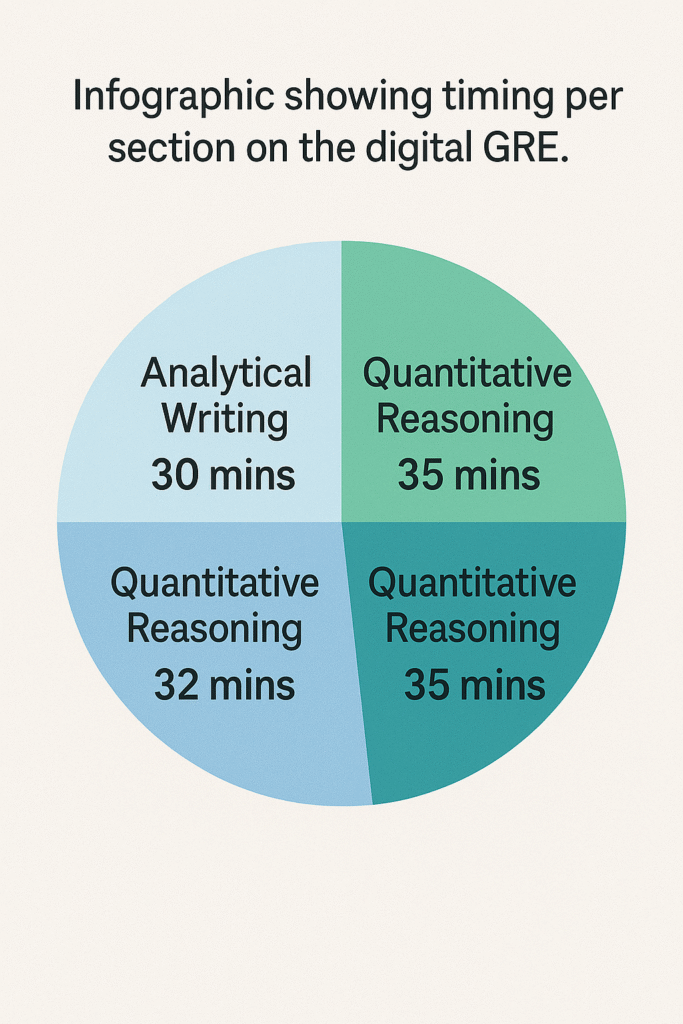
Section | Questions | Time | Avg. Time per Question |
Analytical Writing (AWA) | 1 essay | 30 min | — |
Verbal Reasoning (2 sections) | 27 total | ~41 min | ~1.5 min |
Quantitative Reasoning (2 sections) | 27 total | ~47 min | ~1.7 min |
📌 Total test time: ~1 hour 58 minutes
📝 There may also be one unscored experimental section. Treat it like a scored one — you won’t know which is which.
🧠 Why Time Management Is Harder Than It Looks
Many GRE takers underestimate pacing until it’s too late. Here’s why it’s tricky:
- Questions vary in difficulty, but all count equally — wasting time on one tough question costs you others.
- You can’t go back to previous sections — every second counts.
- Overthinking early questions creates panic and leaves you rushing the rest.
- Reading passages and word problems take longer than expected.
- Writing a well-structured essay in 30 minutes feels rushed without a system.
But here’s the truth: with the right pacing strategies and realistic practice, you can train your internal clock and finish each section confidently.
✅ 6 Time Management Strategies That Actually Work
1. 📊 Know Your Time Per Question
It sounds obvious, but many students don’t calculate this. Rough benchmarks:
- Verbal: ~1.5 minutes per question
- Quantitative: ~1.7 minutes per question
⏱️ Tip: Aim to finish each question 10–15 seconds early to build a buffer for harder ones or last-minute review.
2. ⏩ Skip Strategically — and Come Back Later
Don’t get trapped by a single hard question. If you’re stuck:
- Flag it.
- Make an educated guess if needed.
- Move on and return later only if time allows.
🎯 Every GRE question is worth the same. Spending 3 minutes on one tough question could cost you four easier ones.
3. ⌛ Use Benchmarks to Stay on Track
Set mini-goals throughout each section. For example:
Verbal Reasoning (20 min section):
- 6 min → Question 5–6
- 12 min → Question 10–11
- 18 min → Final 2–3 questions
- 2 min → Review flagged items
Quantitative Reasoning (23–24 min section):
- 10 min → ~6 questions done
- 20 min → ~11–12 questions done
- 2–3 min → Final review pass
📌 Use the on-screen timer as a guide, not an obsession. Checking every 10–12 minutes is enough.
Lorem ipsum dolor sit amet, consectetur adipiscing elit. Ut elit tellus, luctus nec ullamcorper mattis, pulvinar dapibus leo.
4. ✍️ Use Process of Elimination — Fast
Even when you don’t know the answer, you can often eliminate 1–2 obviously wrong options quickly.
- Look for choices that contradict key information.
- Spot extreme language (“always,” “never”) — often incorrect.
- Eliminate grammatically inconsistent answers in sentence completions.
🧠 Most answer traps are designed to look tempting but collapse under logical scrutiny. Practicing elimination reduces decision time dramatically.
5. 🛠️ Use Templates and Mental Shortcuts
Templates save time in Analytical Writing, and mental shortcuts speed up Quant.
AWA (Analytical Writing):
- Stick to a clear 5-paragraph essay structure.
- Reuse standard phrases for transitions (Moreover, However, Consequently).
- Avoid over-complicating your vocabulary.
Quantitative:
- Memorize key formulas (percent change, area/volume, probability).
- Internalize fraction-decimal conversions (1/8 = 0.125).
- Know perfect squares up to 20².
The less time you spend “re-deriving” concepts, the more time you save for reasoning.
6. 🧪 Practice Under Real Conditions
Time management is a muscle, and like any muscle, it grows through realistic training.
- Take at least three full-length practice exams before test day.
- Use a timer for every section — no pausing, no interruptions.
- Review not only what you got wrong but how long you spent on each question.
You’ll quickly see where you’re wasting time — and fix it before the real test.
🔍 Section-Specific Time Strategies
📝 Analytical Writing (30 min total)
- Plan/outline: 4–5 minutes
- Write essay: 20–22 minutes
- Revise/edit: 3–4 minutes
🎯 Keep your structure simple and consistent. Focus on clarity and argument strength over fancy words.
📖 Verbal Reasoning (~20 min per section)
- Skim for structure, not detail. Find main ideas, tone, and transitions quickly.
- Prioritize Text Completion and Sentence Equivalence if they’re your strengths.
- Save tone and inference questions for the end if time runs short.
- Read challenging material daily to build reading speed.
📌 Extra resource: check out our guide GRE Verbal Tips for Non-Native Speakers to build reading speed and comprehension effectively.
➕ Quantitative Reasoning (~23–24 min per section)
- Underline key data in word problems to avoid re-reading.
- Don’t spend more than 2 minutes per question.
- Use scratch paper efficiently — don’t rewrite the question.
- Double-check only if you have extra time.
🎯 Your goal isn’t perfection. It’s maximizing your correct answers within the time limit.

🧘 Final Advice: Train Timing Like Any Other Skill
The best GRE prep plans include:
- 📚 Content review (Math, Verbal, Writing)
- ⏱️ Timed practice drills for every section
- 🧪 Full-length mock exams with realistic breaks
- 📊 Review sessions focused on accuracy and pacing
Even a 10–15% improvement in speed can mean answering 2–5 more questions — often the difference between an average and an excellent score.
And remember: finishing comfortably and confidently on test day is a skill you build before the exam, not during it.
🎓 How American School Online Helps You Master GRE Timing
Our GRE prep platform is built around one simple idea: master the clock, master the test. Inside our program, you’ll:
- Practice with real test-timing simulations
- Learn proven pacing strategies for every section
- Get analytics showing exactly where you lose time
- Build a personalized study plan with timed drills
- Work with real instructors who guide you through every step
📚 Start improving your pacing today with our online GRE training and turn timing from your biggest obstacle into your secret weapon.
📌 Related Reading
- How Long Should You Study for the GRE? A Realistic Timeline
- GRE Verbal Reasoning: 7 Tips for Non-Native Speakers
- How to Prepare for the GRE Analytical Writing Section

Author: faraz_sa33d
Instractor






Responses