
✍️ How to Prepare for the GRE Analytical Writing Section (Full Guide)


Why AWA Matters More Than You Think
The Analytical Writing Assessment (AWA) is often the most misunderstood part of the GRE. Many students treat it as an afterthought, focusing almost entirely on Verbal and Quantitative. Big mistake.
Here’s why:
🎓 Top graduate programs — especially in humanities, social sciences, business, and law — often look closely at your AWA score.
🧠 Strong writing skills demonstrate not only language proficiency but also your ability to think critically and argue persuasively.
📈 A well-crafted essay can offset slightly lower scores in other sections by showing intellectual maturity.
In short, AWA is your chance to prove you can think, structure, and write like a graduate student. And the good news? Unlike Verbal vocabulary or Quantitative tricks, writing is a skill you can deliberately train — and improve dramatically — with the right plan.
If you want expert guidance and essay feedback from instructors who specialize in international students, check out our GRE preparation course at American School Online, where we train you for every section — including Analytical Writing.
Overview: The Structure of GRE Analytical Writing ✍️
The AWA consists of two separate writing tasks, each lasting 30 minutes:
- Analyze an Issue – You’ll be given a statement or opinion about a topic. Your job: present a well-reasoned argument for or against it.
- Analyze an Argument – You’ll receive a short argument (often flawed) and must critique its logic, pointing out assumptions, weaknesses, and improvements.
📊 Scoring: Both tasks are scored from 0 to 6 in half-point increments. Your final AWA score is the average of the two.
What the GRE Is Really Testing Here 🧠
AWA isn’t about fancy vocabulary or sounding poetic. ETS is measuring:
- Critical thinking: Can you evaluate claims, identify assumptions, and reason logically?
- Organization: Is your essay structured clearly with an introduction, body, and conclusion?
- Development: Do you support points with specific, relevant examples?
- Clarity and style: Is your writing precise, fluent, and grammatically correct?
Think of it as writing a mini academic essay in 30 minutes. That’s exactly what graduate programs expect you to do regularly.
Lorem ipsum dolor sit amet, consectetur adipiscing elit. Ut elit tellus, luctus nec ullamcorper mattis, pulvinar dapibus leo.
The “Analyze an Issue” Task: How to Tackle It 📜
What You’ll See
A typical Issue prompt presents a general statement like:
“Governments should place few, if any, restrictions on scientific research and development.”
Your job is not to simply agree or disagree — but to build a coherent, nuanced argument that supports your position.
Strategy: Step-by-Step Approach
- Read the prompt carefully (2–3 min)
Identify the key claim and any underlying assumptions. - Choose a clear position (1 min)
It’s okay to partially agree or disagree — but be decisive.
✅ “While scientific freedom is vital, ethical oversight is essential to prevent harm.” - Brainstorm 2–3 supporting points (3 min)
Use real-world examples, historical evidence, or logical reasoning. - Outline your essay (2 min)
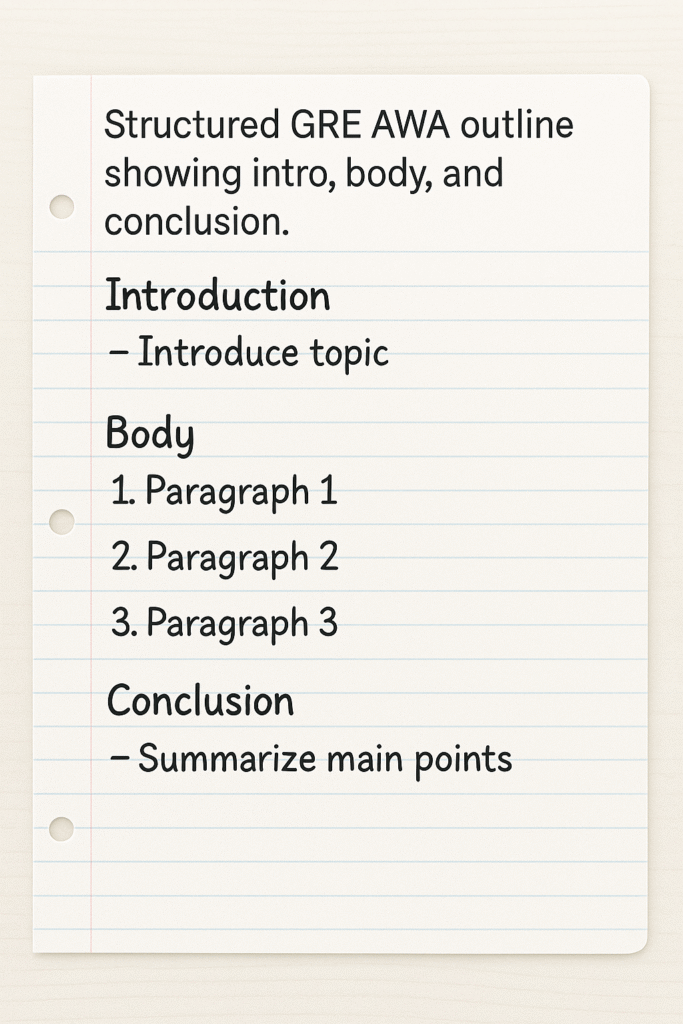
- Intro: paraphrase the prompt + your thesis.
- Body 1: strongest point + example.
- Body 2: second point + example.
- Optional Body 3: counterargument + rebuttal.
- Conclusion: restate thesis and main points.
- Write (20 min)
Stick to your structure and keep arguments clear. - Revise briefly (2–3 min)
Fix grammar, check transitions, tighten sentences.
Pro Tips for the Issue Task
- Don’t try to sound “neutral.” Choose a side and defend it.
- Use specific examples (historical, scientific, or personal) — vague generalizations score lower.
- Address counterarguments briefly to show depth of reasoning.
- Use transitional phrases: Moreover, In contrast, Consequently, For example.
The “Analyze an Argument” Task: How to Master It 📊
What You’ll See
Here, you’re not writing your opinion. You’re evaluating someone else’s argument. For example:
“Because of declining enrollment, the city should close one of its public libraries to save money.”
Your goal: don’t agree or disagree. Instead, analyze the logic. Where are the assumptions? What evidence is missing? What alternative explanations exist?
Strategy: Step-by-Step Approach
- Read carefully and identify the conclusion (2–3 min)
What is the author trying to prove? - Underline key assumptions (3 min)
E.g., “closing one library will save money” assumes other libraries can handle the extra load. - Brainstorm flaws and missing evidence (3 min)
- Correlation ≠ causation
- Small sample size
- Unstated alternative explanations
- Outline your critique (2 min)
- Intro: summarize argument + state you’ll evaluate its logic.
- Body 1: flaw #1 + explanation.
- Body 2: flaw #2 + explanation.
- Body 3: flaw #3 + what evidence would help.
- Conclusion: restate that argument is weak without more data.
- Write (20 min)
Focus on clarity and logical reasoning. - Edit (2–3 min)
Eliminate grammar errors, improve transitions.
Pro Tips for the Argument Task
- Never write “I agree” or “I disagree.” That’s not the task.
- Use phrases like “The argument assumes…” or “This conclusion is flawed because…”
- Suggest what evidence would strengthen the argument.
- Avoid emotional language — stay analytical and objective.
Mastering Structure: Templates That Work 🧱
Having a go-to structure saves precious time. Here’s one for each task:
📜 Issue Essay Template
Intro:
- Paraphrase the prompt.
- State your position.
Body 1:
- Strongest supporting reason.
- Example/evidence.
Body 2:
- Second strong reason.
- Example/evidence.
Body 3 (optional):
- Acknowledge a counterargument.
- Rebut it logically.
Conclusion:
- Restate your thesis and summarize key points.
📊 Argument Essay Template
Intro:
- Restate the argument.
- Say you will evaluate its reasoning.
Body 1:
- Identify a key flaw.
- Explain why it weakens the argument.
Body 2:
- Second flaw + reasoning.
Body 3:
- Third flaw + what evidence could fix it.
Conclusion:
- Summarize why the argument is unconvincing without stronger evidence.
-683x1024.png)
Practice Techniques That Actually Work 💡
🧠 1. Write Under Real Conditions
Simulate exam time limits (30 minutes). Train both speed and structure.
📚 2. Review Sample Essays
ETS publishes sample essays with score explanations. Analyze what makes a 5.5 different from a 3.0.
📝 3. Use a Feedback Loop
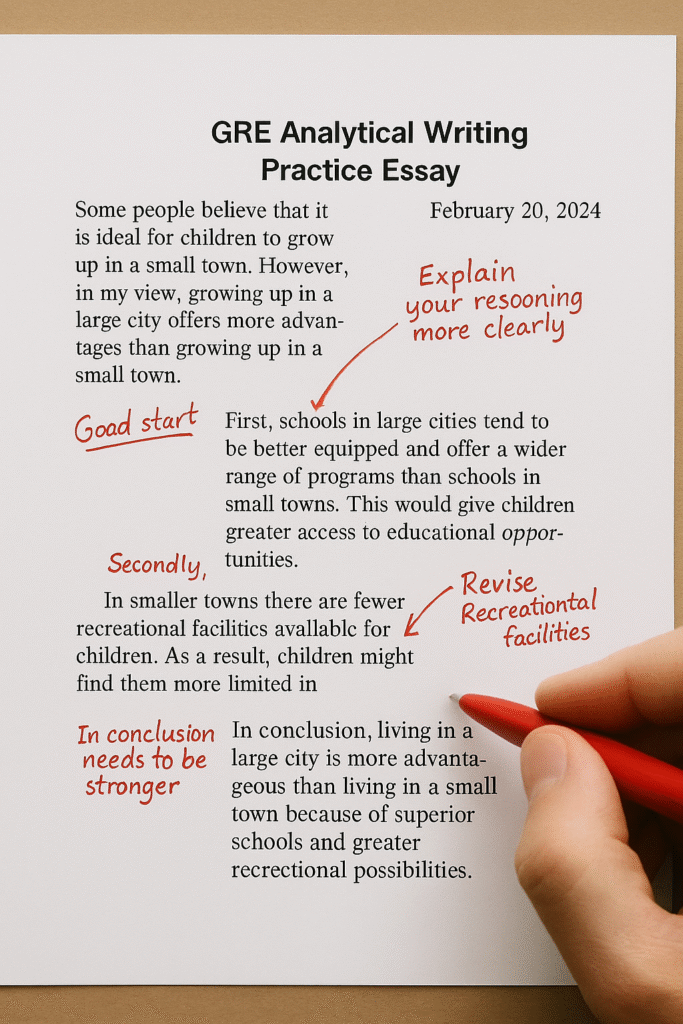
Write essays, then revise them 24 hours later. Look for vague language, weak examples, or poor transitions.
🔁 4. Build a Database of Examples
Keep a list of versatile examples (historical events, scientific discoveries, case studies) to use in Issue tasks.
🧪 5. Study Argument Patterns
Practice spotting common flaws:
- Assumptions without evidence
- Overgeneralization
- False cause
- Unrepresentative data
Common Mistakes to Avoid ❌
- ❌ Writing your opinion on the Argument task. (Always analyze, never agree/disagree.)
- ❌ No clear thesis. Your essay must state a position or main idea clearly.
- ❌ Overcomplicating language. Clarity beats complexity.
- ❌ Ignoring structure. Without intro, body, conclusion — your score drops.
- ❌ Not proofreading. Grammar mistakes can lower your score even if your ideas are strong.
Timing Strategy: The 30-Minute Breakdown ⏱️
Phase | Task | Time |
Read + Plan | Understand the prompt, pick a side | 5–6 min |
Outline | Structure intro, points, conclusion | 2–3 min |
Write | Draft essay | 18–20 min |
Revise | Fix grammar, improve clarity | 3–5 min |
Do this consistently, and you’ll never feel rushed again.
How AWA Is Scored (and What High-Scorers Do Differently) 📈
Each essay is scored twice — once by an AI and once by a human rater. If scores differ significantly, a second human reads it.
What 5.5–6.0 essays do well:
- Clear, sophisticated thesis
- Logical development of ideas
- Specific, well-chosen examples
- Varied sentence structure and precise vocabulary
- Few grammatical errors
What 3.0–3.5 essays do poorly:
- Weak or missing thesis
- Disorganized structure
- Generalizations without support
- Repetitive vocabulary or awkward phrasing
- Many language errors
Final Checklist Before Test Day ✅
- Can I write a clear, structured essay in 30 minutes?
- Do I have examples ready for common Issue topics?
- Can I identify at least 3 flaws in any Argument passage?
- Do I use transitional phrases effectively?
- Have I practiced proofreading under time pressure?
Conclusion: AWA Is a Skill — And Skills Can Be Trained 🎓
The Analytical Writing section isn’t about being a “natural writer.” It’s about mastering a repeatable process: read critically, plan quickly, argue clearly, and revise intelligently.
Thousands of non-native speakers earn 5.0+ scores every year — not because they’re geniuses, but because they prepared with structure and intention. Follow the steps in this guide, and you’ll do the same.
And if you want structured feedback, essay scoring, and templates tailored to your goals, join our GRE preparation course at American School Online.

Author: faraz_sa33d
Instractor






Responses